Announcing the Wonderful AI Gateway: Every AI dollar, by team and by task
Know where AI spend goes and what it buys. Then make it go further.

SaaS sprawl took a decade to build, and enterprises are still paying for it. Agent sprawl is following the same path in a matter of months, and it is both bigger and faster. It is already leaving behind duplicate tools, apps nobody approved, and bills nobody can fully explain. Unlike SaaS, it also spends money on its own, which is why it needs a control layer now, rather than a cleanup project in five years.
Meet Wonderful AI Gateway
The Wonderful AI Gateway is generally available today as the control layer of the Wonderful AI OS. It sits between a company’s AI tools and the model providers they rely on. Once a tool is pointed at the Gateway, every model call from that tool to any provider passes through one place: whether it comes from a developer’s coding agent, a support agent on a voice platform, or a back-office document processing agent. Once all of that traffic runs through a single point, the enterprise gets one view and one policy for all of it.
Spend analytics and forecasting
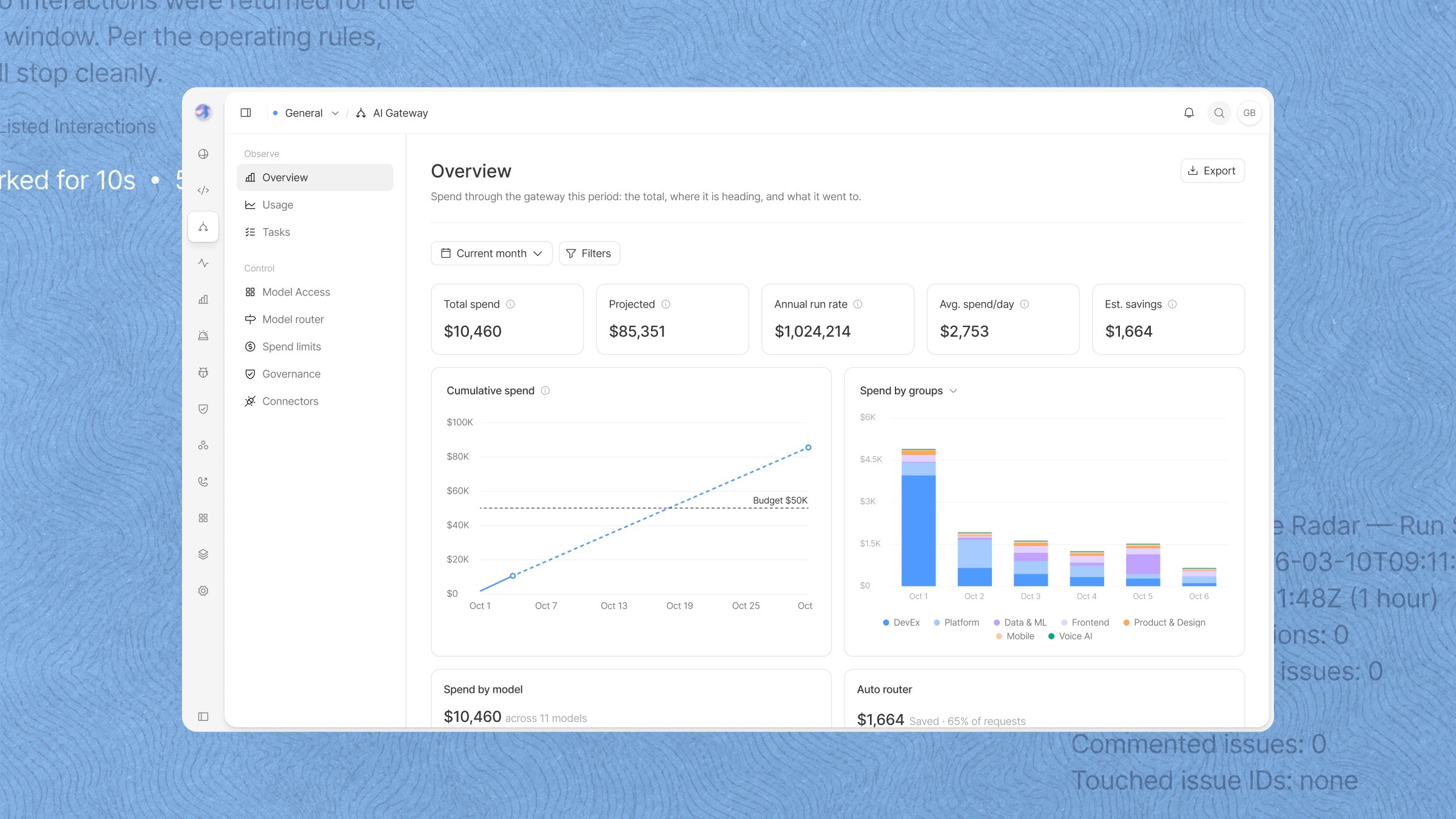
The first thing the Gateway provides is a clear picture of spend. It shows what was spent through it in the current period, where that spend is heading, and what it went to, broken down by department, team, user, source, task, and model. Any individual request can be traced back to the model that served it and the reason that model was chosen. A projection runs against the budget so next month’s bill is not a surprise, and anomalies are flagged as they happen rather than when the invoice arrives. As a result, when a cost spike needs explaining or an auditor has a question, the answer is already there.
Session-level cost tracking

Session-level tracking takes this a step further by turning AI spend into unit economics, meaning what each piece of work actually costs. Every session the Gateway serves is listed with its source, user, model, and cost, across every team and workflow. That per-task cost is the number to hold against the value of the work itself, whether that is a claim resolved, a contract reviewed, or a feature shipped. The Gateway also tells you what the spend bought: what each user, team or agent got done in a given period, clustered by topic and rolled up across people, agents and tools into one view of the work, so you can read cost against output.
Usage and access controls

Where visibility shows how AI is being used, usage and access controls determine how it can be used. Each team or role gets its own access, covering which models it can reach and how much it can spend, and those limits are enforced before a request ever reaches the model. Spend rules follow the same logic, since each one sets a monthly amount, defines what happens when it is reached, and specifies who is alerted on the way there. Enterprises can reserve premium models for R&D or open them to every team, depending on how they want to work. These rules apply no matter which tool a request comes from, and budget owners can see who is near or over a limit, with the ability to override and review.
Usage rules also define what AI can be used for and what data it can see. Off-topic requests, such as planning a trip or building a personal app on a company account, are blocked, and customer data and other sensitive information are redacted before they reach an external vendor.
Dynamic model routing
Given the choice, employees default to the premium model regardless of the task, so the Gateway includes a model router that decides request by request. The router reads each request’s task type and complexity and picks the most cost-effective model that can complete it without losing quality, logging every decision along the way. It only chooses from the models approved for that user, team, or task, so routing never works around policy. When a provider goes down, it moves traffic to a fallback automatically. The same setup simplifies rolling out new models, since a model is added once and reaches every team approved to use it.
Scale the AI spend that pays off
The goal is not to spend less on AI, but to see what each dollar produced and scale what works as fast as teams can adopt. With the Gateway in place, every team keeps the tools it chose and gets the newest models, while the enterprise controls every model, every team, and every dollar without becoming the bottleneck. Every AI dollar now comes with a receipt.